 Siddharth Saoji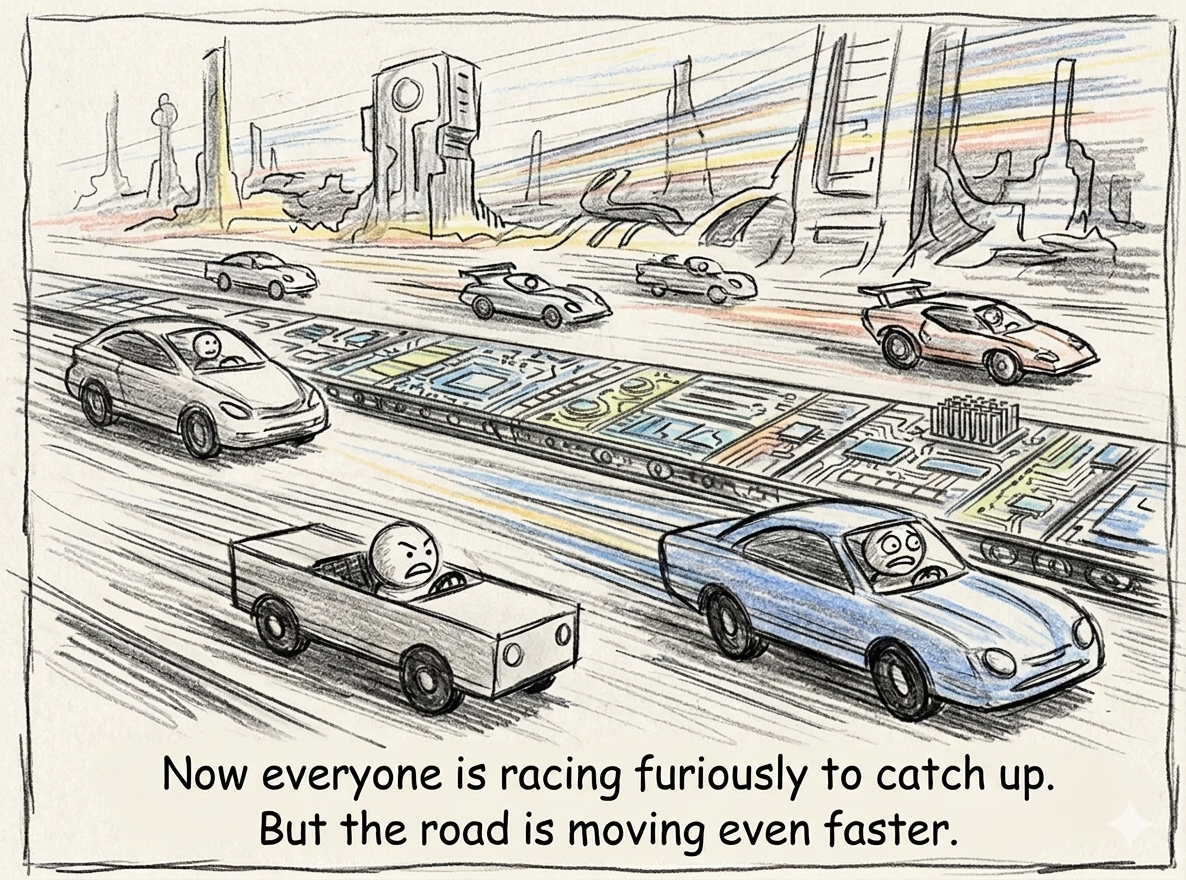
Everyone working in AI today is working more than they used to. Not a little more. Noticeably more. The kind of more that shows up in sleep schedules and weekend plans and the quiet retirement of hobbies.
This is strange, because AI was supposed to do the opposite.
The promise was efficiency. Automate the repetitive parts. Compress the boring work. Do in hours what used to take days. And it delivered — technically. The individual tasks got faster. The output per hour went up. And yet the total hours went up too.
Nobody talks about why.
The easy answer is competition. More people are building, so you have to build harder. True. But incomplete.
In almost every other field, the competitive landscape is fixed. You race other companies on stable ground. Somebody executes better, somebody raises more money, somebody gets lucky. The ground does not move.
In AI, the ground moves.
The model powering your product today is commoditised in three months. The architecture you committed to last quarter is the legacy architecture this quarter. You are not building on a foundation. You are building on a treadmill.
Which produces a formula that is simple and a little brutal:
V_eff = (V_you − V_comp) − V_landscape
Your effective progress is not just how much faster you move than competitors. It is that gap, minus whatever the landscape takes from both of you. The landscape is not a neutral backdrop. It is a player. It extracts from everyone equally and does not negotiate.
This creates a trap most builders do not see until they are in it. You can be winning the competitor race — genuinely pulling away — and still have V_eff < 0. Because if the landscape moves fast enough, both of you are sliding backward relative to the frontier. You are just doing it more gracefully.
The best dinosaur. The asteroid already hit.
This should produce burnout. A race with no finish line, against a landscape that does not negotiate — classical psychology predicts retreat.
Instead, the opposite keeps happening.
Every landscape shift also brings something genuinely new into the world. Not an incremental improvement. An actual expansion of what is possible. And something about that novelty fires a curiosity that quietly overrides the fatigue. Persistently. Across a surprising number of people. In a way that does not match any prior model of how humans respond to unsustainable conditions.
The aha is this: the landscape is not just the thing wearing everyone down. It is also the thing keeping everyone in. The same velocity making V_eff go negative is generating the novelty making people accelerate again. The obstacle and the fuel are the same variable.