 Siddharth Saoji
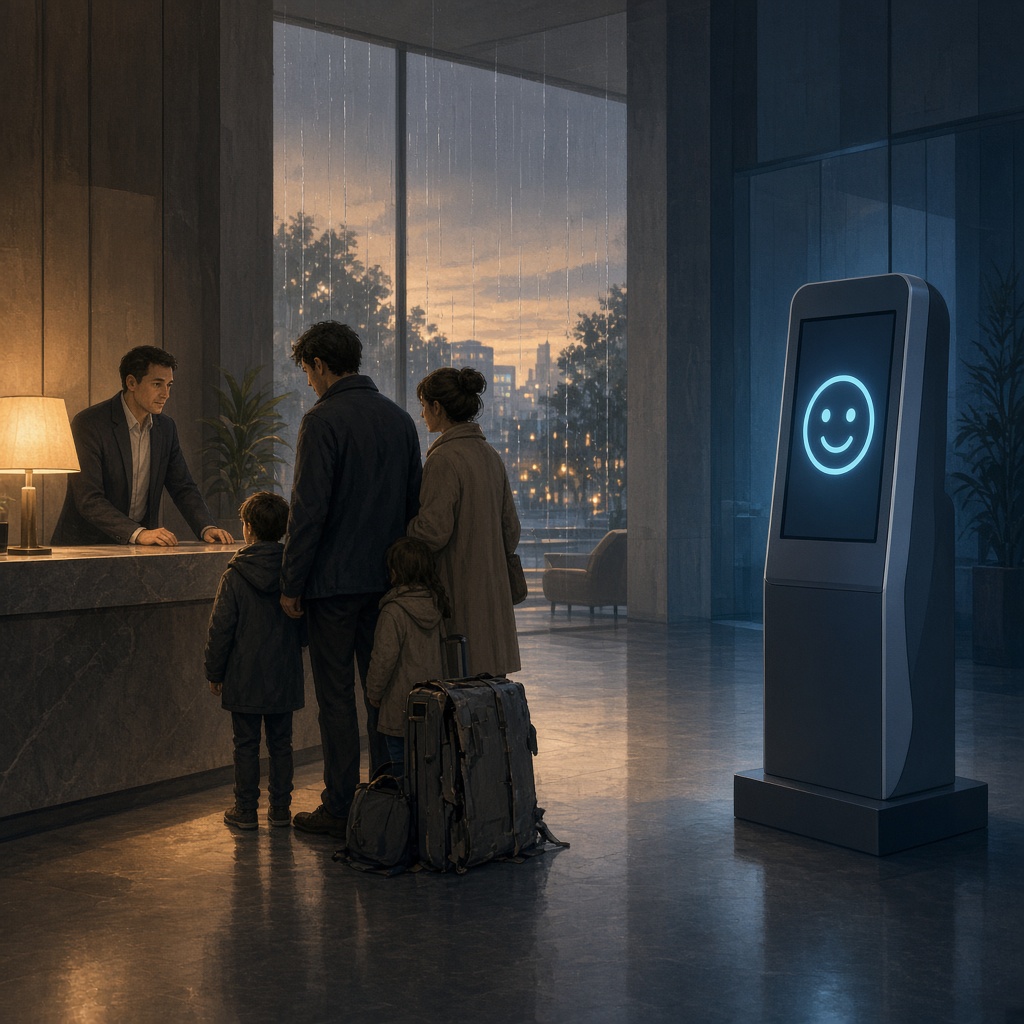
Imagine arriving at a hotel with two tired children, a suitcase that has lost a wheel and a weather warning arriving on your phone. You ask a question that was not in the FAQ. The person at the desk looks at you, looks at the children, glances outside, and quietly changes the answer.
That small adjustment is difficult to describe as a workflow. It is closer to judgement.
This is the part of service that tends to disappear when we talk about making it more efficient with AI. We imagine the interaction as a series of requests and responses: check in, answer question, take payment, print receipt. AI can do all of this rather well. But people do not experience service as a flowchart. They experience it as a situation.
A person behind a reception desk is constantly collecting details that were never entered into a system. A pause before speaking. Someone scanning the room for help. A family that needs more time but is too embarrassed to ask. A customer whose tone suggests that the problem is not really the problem.
Body language is an untidy kind of data. It is also often the most useful kind.
There is another curious thing about human service: it is not always the expensive option. The most capable AI models are becoming cheaper, but not necessarily cheap enough for every customer-facing interaction, in every geography. Sometimes a person is simply the better bargain, especially when the job keeps changing shape.
Ask a receptionist to help sort inventory and, after a little explanation, they can probably do it. Ask them to handle an unusual request, calm a frustrated customer or help another team for an afternoon, and they bring along a lifetime of context. They are generalists without needing to be installed as one.
An AI system, by contrast, can be remarkably capable inside the edges of the task it has been given. The difficulty is that the edges keep moving.
And then there is the thing that is hardest to put on a specification sheet, culture.
An AI agent can be given a warm persona. It can sound patient, cheerful and attentive. But a persona is something an agent performs. Culture is something people build together through habits, stories, small acts of generosity and the way knowledge passes from one worker to the next.
You can design an AI to greet a customer. It is harder to design the feeling that someone has been genuinely welcomed.
Perhaps the interesting question is not whether AI can replace the person at the desk. It probably can, in some places and for some tasks. The question is what we might stop noticing when there is no one there to read the room.